Enterprise Learning Path

Certification programs built for real enterprise environments.

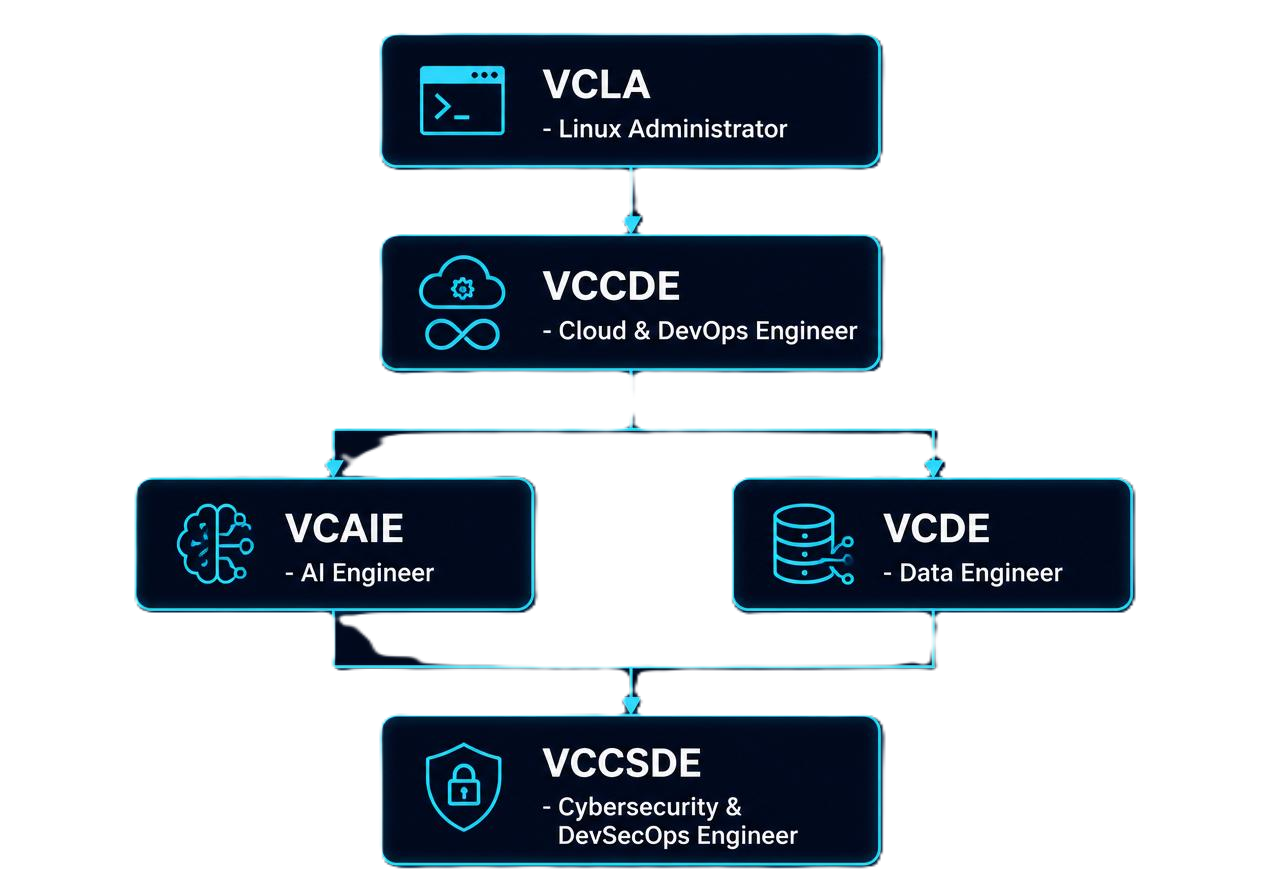
A structured learning journey — from Linux fundamentals to Cloud & DevOps, then specialized tracks in AI, Data and Cybersecurity.

ViBhu certification path: VCLA → VCCDE → VCAIE / VCDE → VCCSDE
Why ViBhu

Why choose the ViBhu Learning Path?

Foundation First

Build strong Linux administration skills that form the basis of cloud and platform engineering.

Enterprise-Ready Skills

Master Cloud & DevOps using the same tools, technologies, and practices adopted by leading organizations.

Specialized Career Tracks

Advance into AI Engineering, Data Engineering, or Cybersecurity based on your career goals.

Hands-on Learning

Learn through practical labs, real-world scenarios, and enterprise-grade projects.

Industry-Relevant Curriculum

Continuously updated to align with modern technologies and enterprise best practices.

Certification Programs

Explore each ViBhu Certified program.

VCLA

ViBhu Certified Linux Administrator

Build a strong foundation in Linux administration and enterprise infrastructure. This program covers everything from Linux installation and system management to networking, storage, security, shell scripting, and performance tuning. Through extensive hands-on labs and real-world scenarios, you'll gain the practical skills required for System Administration, Cloud Engineering, and DevOps roles while preparing for Red Hat certification concepts.

Course Modules

Linux Foundations

  • Linux Architecture & Distributions
  • Linux Filesystem Hierarchy (FHS)
  • Linux File Types & Inodes
  • Hard & Soft Links
  • Linux Installation
  • Cloud VM Installation
  • Initial System Configuration
  • Linux Command Line & CLI

Files, Shell & Productivity

  • Navigation & Directory Management
  • File Management & Viewing
  • Vim & Text Editors
  • Configuration Files
  • Search & File Discovery
  • Pipes & I/O Redirection
  • Text Processing
  • Archiving & Compression
  • Bash Shell Environment
  • Environment Variables & PATH
  • Aliases & Command History
  • Shell Productivity

System Administration

  • System Information & Hardware
  • Package Management & APT
  • DEB Packages & Repositories
  • Users & Groups Management
  • Password & Account Management
  • File Permissions & Ownership
  • umask & Special Permissions
  • Access Control Lists (ACL)
  • Processes & Process Management
  • Process Priorities & Background Jobs
  • Cron & Task Scheduling
  • Services & systemd
  • systemctl & Service Management
  • journalctl & System Logging

Storage & Filesystems

  • Disk Partitioning
  • Filesystem Management
  • Mounting & /etc/fstab
  • Disk Usage & Space Management
  • Swap Management
  • Logical Volume Manager (LVM)
  • Physical Volumes (PV)
  • Volume Groups (VG)
  • Logical Volumes (LV)
  • LVM Snapshots

Networking & Security

  • Linux Networking Fundamentals
  • Network Interfaces & IP Configuration
  • Hostname Management
  • DNS
  • Routing & Gateways
  • SSH & Secure Remote Access
  • Network Troubleshooting
  • Linux Firewall
  • iptables
  • firewalld
  • SELinux
  • SSL/TLS
  • IPSec VPN
  • Linux Security Hardening

Identity & Enterprise Infrastructure

  • LDAP Server
  • LDAP Client Configuration
  • High Availability LDAP
  • Enterprise Authentication
  • Apache Guacamole
  • Enterprise Remote Access

Automation, DevOps & Cloud

  • Ansible
  • Terraform
  • Infrastructure as Code (IaC)
  • Git
  • GitHub
  • Jenkins
  • SonarQube
  • CI/CD Fundamentals
  • Docker
  • Kubernetes
  • AWS CLI
  • Cloud Infrastructure
  • Cloud-Native Operations

Data & Enterprise Platforms

  • Apache Airflow
  • Apache Spark
  • JupyterHub
  • Data Engineering Workflows
  • Snowflake
  • MongoDB
  • MariaDB
  • Aerospike
  • Enterprise Database Administration

Observability & Production Operations

  • Linux Logging & Log Management
  • logrotate
  • ELK Stack
  • Elasticsearch
  • OpenSearch
  • Prometheus
  • Grafana
  • Loki
  • System Monitoring
  • Metrics & Logs
  • Alerting & Incident Management
  • PagerDuty
  • Enterprise Observability
  • Production Operations
  • Infrastructure Automation
  • Hands-on Labs & Playbooks
  • Enterprise Projects
  • VCLA Certification Preparation

VCCDE

ViBhu Certified Cloud & DevOps Engineer

Master modern cloud platforms and DevOps practices through a comprehensive enterprise-focused curriculum. This flagship program combines cloud computing, containers, Kubernetes, Infrastructure as Code, automation, CI/CD, observability, security, databases, and cloud cost optimization into a single learning path. Students gain practical experience by building, deploying, securing, and managing enterprise-grade cloud-native applications using industry-standard tools and real-world projects.

Course Modules

Cloud Computing

  • Cloud Computing Fundamentals
  • Introduction to Multicloud
  • Amazon Web Services (AWS)
  • Microsoft Azure
  • Google Cloud Platform (GCP)

Version Control & Collaboration

  • Git
  • GitHub

Containerization & Orchestration

  • Docker
  • Kubernetes
  • Helm

Infrastructure Automation

  • Terraform
  • Ansible
  • Infrastructure as Code (IaC)

CI/CD & GitOps

  • Jenkins
  • GitHub Actions
  • GitLab CI/CD
  • ArgoCD (GitOps)

Cloud Administration

  • Cloud Networking
  • Identity & Access Management (IAM)
  • Secrets Management

Database Fundamentals

  • MySQL
  • PostgreSQL
  • MongoDB
  • Redis

Monitoring & Observability

  • Prometheus
  • Grafana
  • Loki
  • Tempo
  • ELK Stack

Security & DevSecOps

  • Trivy
  • HashiCorp Vault
  • Falco
  • Container Image Scanning
  • Policy as Code

FinOps

  • Cloud Cost Optimization

Enterprise Project

  • Enterprise Capstone Project

VCAIE

ViBhu Certified AI Engineer

Learn to design, build, and deploy intelligent AI solutions using modern Large Language Models (LLMs), AI frameworks, and cloud-native infrastructure. This program focuses on practical AI engineering, enabling professionals to create AI-powered applications, intelligent agents, Retrieval-Augmented Generation (RAG) systems, and scalable AI platforms suitable for enterprise environments.

Course Modules

  • Python Programming
  • AI Fundamentals
  • Large Language Models (LLMs)
  • Prompt Engineering
  • Model Context Protocol (MCP)
  • LangChain
  • Retrieval-Augmented Generation (RAG)
  • Vector Databases
  • Ollama
  • Open WebUI
  • AI Agents
  • AI Infrastructure
  • Kubernetes for AI
  • MLOps Fundamentals

VCDE

ViBhu Certified Data Engineer

Develop expertise in building scalable data platforms and modern analytics pipelines. This program covers data ingestion, processing, orchestration, warehousing, and big data technologies, preparing professionals to design enterprise-grade data engineering solutions for analytics, reporting, and AI workloads.

Course Modules

  • SQL
  • PostgreSQL
  • MongoDB
  • Apache Spark
  • Apache Kafka
  • Apache Airflow
  • Trino
  • Snowflake
  • Databricks
  • Data Lakes
  • ETL / ELT Pipelines
  • Data Warehousing

VCCSDE

ViBhu Certified Cybersecurity & DevSecOps Engineer

Protect modern cloud-native applications and enterprise infrastructure with security-first engineering practices. This upcoming program will focus on cloud security, Kubernetes security, DevSecOps, identity management, container security, compliance, vulnerability management, and enterprise security automation to help organizations build resilient and secure digital platforms.

Planned Modules

  • Linux Security
  • Cloud Security
  • Kubernetes Security
  • Identity & Access Management (IAM)
  • Zero Trust Security
  • HashiCorp Vault
  • Trivy
  • Falco
  • SIEM & Log Management
  • Container Security
  • Vulnerability Management
  • Compliance & Governance
  • Incident Response
  • Security Automation
  • DevSecOps Best Practices

Disclaimer

ViBhu Certified programs are industry-oriented professional certification programs developed by ViBhu Technologies. They are independent certifications designed to validate practical skills and should not be interpreted as certifications issued by AWS, Microsoft, Red Hat, Oracle, Google Cloud, HashiCorp, or any other technology vendor. Vendor names and trademarks are used solely to describe the technologies covered in the curriculum.

Ready to start your certification journey?

Talk to us about cohort schedules, corporate training, and customized learning paths.